

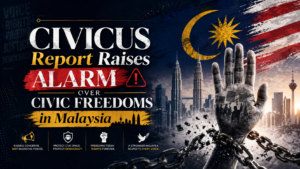
Malaysia’s Civic Space Still ‘Obstructed’, Says CIVICUS Report
Malaysia’s civic freedoms remain under pressure, with global civil society alliance CIVICUS maintaining the country’s status as “obstructed” in its latest report.
The findings, supported by annual data from SUARAM, highlight continuing concerns over laws and enforcement measures that critics say are being used to limit speech, silence dissent, and investigate activists, journalists, and commentators.
Restrictive Laws Remain in Focus
According to the report, authorities continue relying on legislation such as the Communications and Multimedia Act 1998 (CMA), the Sedition Act 1948, the Penal Code, and the Printing Presses and Publications Act.
Human rights advocates argue that these laws are often applied too broadly, especially in cases involving criticism, political opinions, or speech considered offensive.
Data from the Centre for Independent Journalism showed that restrictive laws were invoked 233 times between January and November 2025, a 23% rise compared to the previous year. More than half of those cases were linked to Section 233 of the CMA.
Concerns also grew after 2025 amendments to the CMA expanded investigative powers and introduced harsher penalties, including fines reaching RM1 million.
Activists and Commentators Investigated
The report listed several recent cases involving civil society figures and analysts.
Among them was Pushpan Murugiah of the Centre to Combat Corruption and Cronyism, who was investigated under Section 124B of the Penal Code over alleged activities harmful to parliamentary democracy.
Authorities also questioned academics and commentators, including Ooi Kok Hin, over claims of attempts to destabilise the government.
Meanwhile, activist Fahmi Reza was arrested in December 2025 over a social media post allegedly insulting Johor Regent Tunku Ismail Sultan Ibrahim before later being released on bail.
Pressure on Civil Society and Protests
Civil society groups also faced mounting pressure.
LGBTQI+ organisation JEJAKA cancelled an event in January 2026 after receiving threats and multiple police reports.
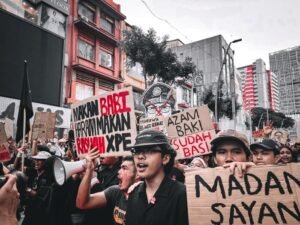
The report also pointed to arrests linked to peaceful protests, including demonstrations over housing demolitions in Selangor and protests demanding accountability from the Malaysian Anti-Corruption Commission.
Student activism was also affected after a sit-in protest at Universiti Malaya was disrupted by auxiliary police, leading to clashes and the seizure of protest materials.
Media Freedom Still a Major Concern
Journalists and independent media outlets continue facing growing pressure.
Investigations were reportedly launched against Malaysiakini, while several reporters were detained or questioned over their work.
The report also cited the assault of journalist Haresh Deol in late 2025 and the arrest of reporter Rex Tan over comments made during a public lecture.
Separate legal actions described as SLAPP lawsuits were also filed against multiple media organisations following investigative reports.
Calls for Reform Grow Louder
Rights groups are urging Malaysia to push ahead with reforms, including ratifying the International Covenant on Civil and Political Rights (ICCPR) and strengthening protections against enforced disappearances.
The government’s move to withdraw its appeal in the case of missing pastor Raymond Koh was welcomed as a positive sign.
However, activists say deeper structural reforms are still urgently needed.
Despite pockets of progress, the latest CIVICUS report makes one message clear: Malaysia’s civic environment remains constrained, with freedom of speech, peaceful assembly, and association still facing serious challenges.
