

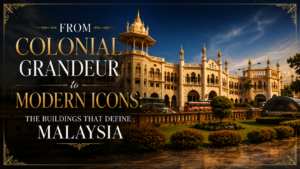
From ornate colonial landmarks to soaring modern skyscrapers, Malaysia’s architecture tells the story of a nation shaped by history, independence and ambition.
Malaysia’s architectural landscape is a reflection of its journey as a nation.
Across Kuala Lumpur, reminders of different chapters in the country’s history stand side by side. The clock tower of the Sultan Abdul Samad Building recalls the colonial era, while the distinctive domes of the Kuala Lumpur Railway Station evoke another period of the city’s development. Rising above the modern skyline, Merdeka 118 represents a very different Malaysia — confident, contemporary and looking firmly towards the future.
Together, these landmarks reveal how dramatically the country has evolved.
Some were built during British rule and inherited by an independent nation. Others emerged in the years following independence, when Malaysia was beginning to establish its own identity. More recent landmarks reflect a country increasingly comfortable with its place on the global stage.
The Kuala Lumpur We Inherited
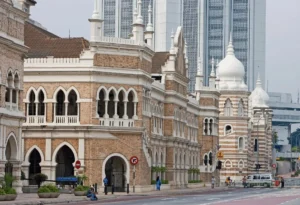
Few landmarks capture the character of old Kuala Lumpur quite like the Sultan Abdul Samad Building.
Completed in 1897, the building was originally constructed to house government administrative offices during British rule. Its striking red-brick exterior, elegant arches, copper domes and prominent clock tower quickly established it as one of the city’s defining architectural landmarks.
Yet its significance has changed considerably over the decades.
Located opposite Dataran Merdeka, the building witnessed a pivotal moment in Malaysian history. On 31 August 1957, the British Union Jack was lowered and the flag of independent Malaya was raised, marking the country’s independence.
The symbolism was powerful. A building once associated with colonial administration had become part of the setting for the birth of a new nation.
Just a short distance away, the Kuala Lumpur Railway Station offers another glimpse into the city’s colonial past.
With its elaborate arches, domes and minaret-like features, the station is recognised for its distinctive Moorish inspired architecture. For decades, it also served as an important railway hub, playing a central role in Kuala Lumpur’s development before the emergence of KL Sentral.
Today, the station serves a very different purpose, but its architectural character remains an important part of the city.
Both buildings were created for a Kuala Lumpur that looked very different from the metropolis of today. More than a century later, however, they continue to occupy a place within the city’s living landscape.
When Architecture Began to Express Independence
Independence represented more than a political transformation. It gave Malaysia an opportunity to develop an architectural identity of its own.
One of the most significant landmarks from this period is Stadium Merdeka.
It was here, on 31 August 1957, that Tunku Abdul Rahman proclaimed Malaya’s independence. Unlike the imposing colonial-era buildings surrounding Dataran Merdeka, the stadium belonged to a new chapter — one in which the country was beginning to define itself on its own terms.
Its importance is therefore rooted as much in memory as in architecture.
Stadium Merdeka became closely associated with one of the defining moments in the nation’s history. Decades later, its original 1957 appearance was carefully restored, with restoration works carried out between 2005 and 2008.
Preserving the stadium was not simply an exercise in conserving an old structure. It was a way of preserving the memory attached to the place.
That distinction is important when considering Malaysia’s architectural heritage. A building does not necessarily have to be the oldest or most elaborate to become significant. Sometimes, its greatest value lies in the stories it carries.
A Skyline Shaped by Ambition
As Malaysia developed economically, its architecture began to change once again.
The country’s cities grew taller, commercial districts expanded and new landmarks emerged to represent a more modern and outward looking Malaysia. Architecture increasingly became a statement of ambition not only reflecting economic growth but also projecting an image of confidence.
Kuala Lumpur’s skyline became the clearest expression of this transformation.
Modern towers began appearing alongside historic structures, creating a cityscape in which different generations of Malaysian architecture could exist within the same horizon.
Among the most recognisable examples are the Petronas Twin Towers, which became an international symbol of Kuala Lumpur after their completion in the late 1990s. Their distinctive design combined contemporary engineering with architectural references inspired by Islamic geometry, creating a landmark that was unmistakably modern while still connected to the region’s cultural context.
The towers represented a Malaysia eager to make its presence felt beyond its borders.
Looking Towards the Future
That ambition has continued into the 21st century.
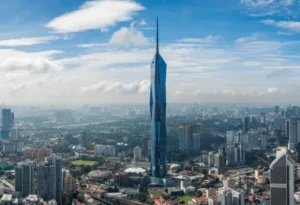
Few contemporary landmarks demonstrate it more dramatically than Merdeka 118. Rising above Kuala Lumpur, the skyscraper has become one of the most striking additions to Malaysia’s skyline and a powerful symbol of the country’s aspirations.
Its name itself carries historical significance, connecting the building to the idea of independence, while its scale and contemporary design point towards the future.
In many ways, Merdeka 118 represents the latest chapter in a much longer architectural story.
The Sultan Abdul Samad Building speaks of colonial Kuala Lumpur. Stadium Merdeka recalls the birth of an independent nation. The Petronas Twin Towers reflect Malaysia’s emergence as a modern economic centre, while Merdeka 118 projects an image of a country looking ahead.
Together, they demonstrate that architecture is rarely just about buildings.
It is also about identity, memory and ambition.
Malaysia’s architectural landscape continues to evolve, but the most meaningful landmarks are those that connect the past with the present. As new structures reshape the skyline, the older buildings remain reminders of where the country began ensuring that progress does not have to come at the expense of memory.
