

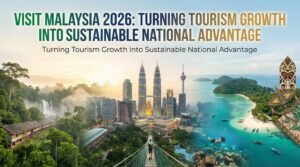
Visit Malaysia 2026: A Defining Moment for Sustainable Growth
As Visit Malaysia 2026 gains momentum, tourism has once again taken centre stage in Malaysia’s economic narrative. Visitor arrivals are rising, confidence is returning, and tourism-linked industries are re-emerging as drivers of employment, investment, and regional development. For businesses and capital markets, the sector’s rebound sends a clear signal of renewed opportunity.
Yet beyond growth figures lies a more consequential question: Can Malaysia scale its tourism ambitions without amplifying environmental, social, and governance (ESG) risks? In today’s investment landscape, these risks are not peripheral they directly affect asset values, operating costs, regulatory exposure, and long-term competitiveness.
The impact of tourism growth is most visible in heritage cities such as George Town and Melaka, and in island destinations including Langkawi, Tioman, and Redang. While demand recovery has revitalised these locations, it has also intensified pressure on infrastructure, public services, and local governance systems areas already operating near capacity.
From an environmental standpoint, many destinations continue to expand without clearly defined carrying limits. Sustainability features prominently in promotional narratives, yet enforceable thresholds for visitor numbers, waste management, water use, and ecosystem stress remain limited. Growth often accelerates automatically with demand, rather than being strategically managed.
This reactive approach increases the likelihood that environmental degradation is addressed only after it becomes costly or politically visible. For businesses and investors, such uncertainty heightens risk. Sudden regulatory tightening, emergency clean-up initiatives, or operational restrictions can materially disrupt returns when sustainability is not embedded from the outset.
Climate risk further compounds these challenges. Tourism contributes significantly to emissions through transportation, energy use, and intensive resource consumption. At the same time, many destinations are already vulnerable to flooding, coastal erosion, storms, and heat stress. While national development plans recognise these threats, tourism expansion remains loosely aligned with climate adaptation and infrastructure resilience leaving destinations exposed to disruption and long-term value erosion.
The social dimension of ESG is equally critical. Data from the Department of Statistics Malaysia (DOSM) consistently show housing, utilities, and food as the largest components of household spending. Meanwhile, domestic tourism expenditure surpassed RM100 billion in 2024, with food and beverage accounting for a significant share.
In high-tourism zones, demand for short-term accommodation and visitor-focused services drives up prices for housing and daily necessities. While tourism creates income for some, it increases living costs for others—particularly service workers and lower-income residents who form the backbone of the industry. Over time, this imbalance manifests as labour shortages, rising wage pressures, and declining service quality. A tourism model that displaces its own workforce is not economically sustainable.
At the core of these environmental and social pressures lies governance capacity. Local councils are tasked with waste management, enforcement, infrastructure upkeep, and environmental monitoring, yet many operate with constrained budgets and fragmented data systems. The gap between national tourism ambitions and local execution represents a structural ESG risk.
Weak governance creates uncertainty for businesses: inconsistent enforcement, reputational spillovers, and abrupt regulatory responses once issues escalate. Strong governance, by contrast, offers predictability clear zoning, transparent licensing for short-term rentals, and consistent standards that allow firms to plan and invest with confidence.
This governance gap also complicates ESG accountability at the corporate level. While many tourism operators now make sustainability claims in response to investor and consumer expectations, reporting remains largely voluntary and uneven especially among small and medium-sized enterprises. Without common benchmarks or clearer disclosure requirements, sustainability performance is difficult to assess, compare, or verify.
From a capital market perspective, this raises concerns around greenwashing and social washing. As ESG-linked financing and responsible investment frameworks expand, tourism businesses lacking credible data and governance structures may face higher financing costs or reduced access to capital. Conversely, firms that invest early in measurable, verifiable ESG practices are likely to gain strategic advantage.
Crucially, ESG-aligned tourism does not mean constraining growth. It means redefining growth prioritising quality over volume, encouraging longer stays, dispersing visitors more effectively, and strengthening local supply chains. These shifts can deliver stronger returns without proportionately increasing environmental and social pressure. While such principles appear in policy documents, stronger implementation signals are needed to meaningfully influence business behaviour.
A key area requiring attention is the readiness of local councils to act as effective destination managers. Sustainable tourism ultimately succeeds or fails at the local level. Yet many councils lack integrated data on visitor flows, waste volumes, water usage, and environmental stress indicators. Without this visibility, decision-making remains reactive rather than anticipatory amplifying long-term ESG exposure for both public authorities and private operators.
There is also growing momentum to integrate tourism sustainability into financial reporting and risk management frameworks. As climate-related and social disclosures become standard practice, tourism businesses will increasingly be expected to identify and manage destination-level ESG risks ranging from infrastructure dependency to environmental degradation and community sentiment. Treating these factors as material risks marks a fundamental shift in how value creation is defined.
Visit Malaysia 2026 is therefore more than a marketing campaign. It is a real-time test of Malaysia’s ability to align tourism growth with ESG discipline. Success will not be measured solely by visitor numbers or headline revenue, but by whether destinations remain investable, communities remain supportive, and environmental liabilities are contained.
Tourism growth has returned. The strategic challenge now is ensuring that this growth strengthens rather than undermines Malaysia’s ESG credibility and long-term economic resilience.


