

Philippine Economy Slows Sharply Central Bank Signals Last Cut
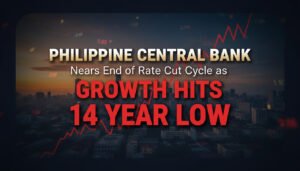
The Philippines’ central bank has delivered its sixth consecutive rate cut, signaling that its monetary easing cycle may soon be coming to an end as economic growth slows to its weakest pace in 14 years outside the pandemic period.
The Bangko Sentral ng Pilipinas (BSP) lowered its benchmark interest rate by 25 basis points to 4.25% at its February 26 policy meeting, aligning with market expectations. Overnight deposit and lending rates were adjusted to 3.75% and 4.75%, respectively.
With this move, the BSP’s total rate reductions since August 2024 now stand at 225 basis points, marking one of the most aggressive easing cycles in recent years.
Why the Cut?
The central bank cited a manageable inflation environment, which provided room to stimulate an economy under pressure. Domestic demand has softened significantly, compounded by the fallout from a major infrastructure-linked corruption scandal that dented investor confidence.
Adding to the strain were a series of destructive typhoons and mounting global trade uncertainties, all of which weighed heavily on business sentiment.
Growth Slows Sharply
Economic growth decelerated to approximately 3.0% year-on-year in Q4 2025, down from 3.9% in the previous quarter. This places the Philippines among the weakest-performing economies in the region during the period.
Although the inflation forecast for 2026 was slightly revised upward due to temporary supply pressures, policymakers remain confident that inflation will gradually return to the 3% target by 2027.
Is This the Final Cut?
The BSP hinted that the easing cycle may be nearing its conclusion. According to research firm MBSB, policymakers acknowledged that there is “not a lot” more monetary policy can accomplish at this stage to further boost growth.
While the central bank projects that a recovery could emerge in the second half of 2026, the trajectory will depend largely on how quickly consumer and investor confidence can rebound.
For now, the Philippines stands at a critical economic crossroads balancing inflation control with the urgent need to restore growth momentum.


