

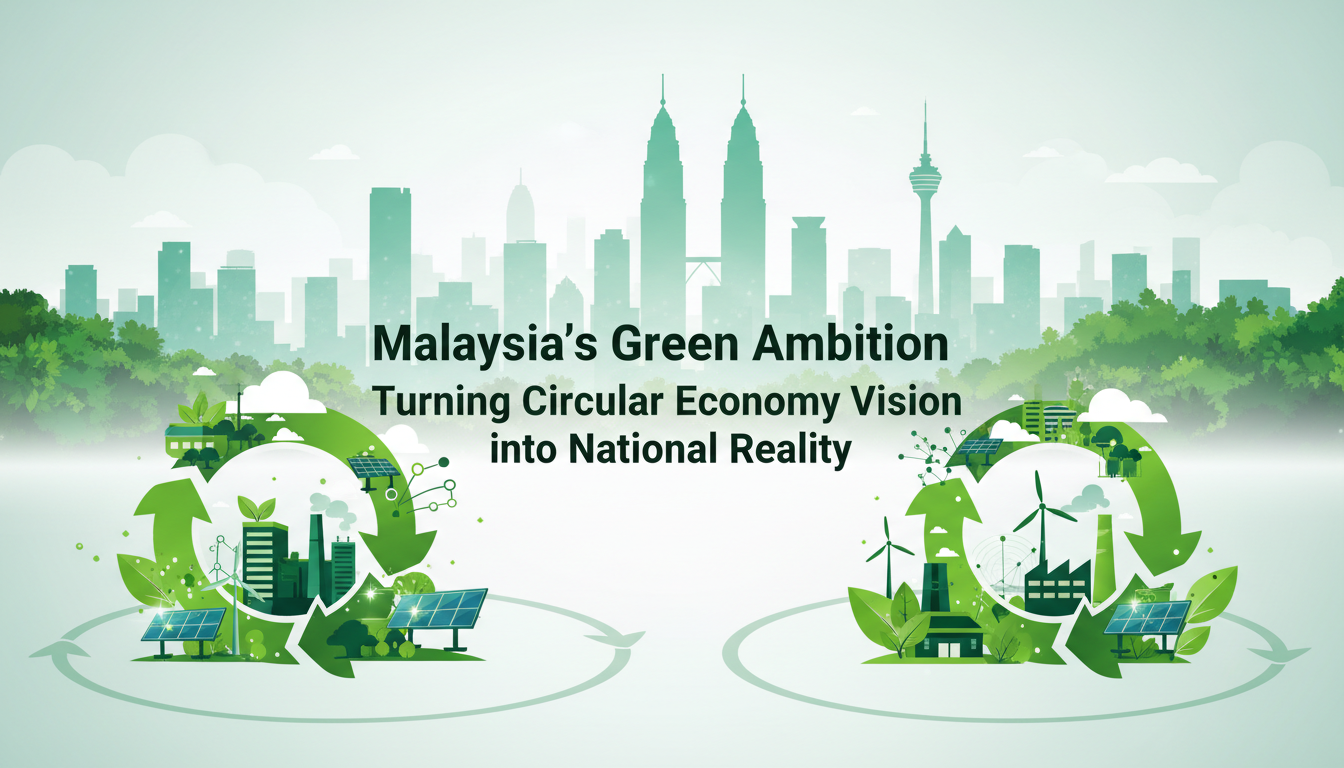
Malaysia’s push toward a circular economy marks more than a policy milestone it is a long-overdue recognition that the traditional “take-make-dispose” model has reached its limits. As environmental pressures, resource scarcity, and global sustainability demands intensify, Malaysia stands at a defining crossroads: remain anchored to a linear past, or boldly redesign its economic future.
For years, the country has spoken the language of green growth. Now, the challenge is execution moving from fragmented initiatives to a coordinated, system-wide transformation.
There is progress to build upon. Strategic frameworks such as the Green Technology Master Plan (2017–2030) and Industry4WRD have linked sustainability with technological advancement, setting targets for emissions reduction, renewable energy adoption, and green innovation. In the energy sector, Malaysia has begun diversifying its power mix, with a commitment to achieve 40% renewable energy capacity by 2035 a signal that has already strengthened investor confidence.
Certain industries are proving that circularity can be profitable. The palm oil sector, often scrutinised globally, has emerged as a circular economy frontrunner. Agricultural waste is increasingly transformed into bio-compost, bio-pellets, and value-added by-products. At the corporate level, Environmental, Social, and Governance (ESG) practices are gaining traction, with publicly listed companies publishing sustainability reports and improving transparency under global supply chain pressure.
Yet despite these achievements, structural weaknesses persist. Green initiatives remain siloed across ministries overseeing energy, environment, housing, and industry resulting in overlapping policies and diluted accountability. A truly circular economy demands integration across these domains.
The most visible shortfall lies in municipal solid waste management. Malaysia remains heavily dependent on landfills, while large-scale separation-at-source programmes and recycling infrastructure lag behind. Without efficient collection, sorting, and recovery systems, circular loops for everyday materials remain stubbornly open.
Economic realities further complicate the transition. Virgin materials are often cheaper than recycled alternatives due to subsidies and the high costs of reverse logistics. For SMEs the backbone of Malaysia’s economy the initial investment required to adopt circular models can be prohibitive. Meanwhile, a deeply ingrained culture of convenience and single use consumption continues to undermine progress, despite rising public awareness.
This is where Malaysia’s national circular economy framework must move decisively from vision to action.

First, the country needs integrated national legislation. A dedicated Circular Economy Act would provide legal clarity, harmonise policies, set enforceable targets for waste reduction and recycled content, and clearly assign responsibility across government agencies.
Second, market demand must be activated. The implementation of Extended Producer Responsibility (EPR) schemes should be accelerated, making producers accountable for the end-of-life impact of their products and packaging. This alone would stimulate demand for recycled materials and drive eco-design innovation. Complementary measures tax incentives for recycled content, green public procurement, and levies on virgin materials and landfilling would help level the economic playing field.
Infrastructure investment is equally critical. Public-private partnerships are needed to develop material recovery facilities, composting plants, and recycling hubs nationwide turning waste into economic opportunity.
The roadblocks ahead are real. Circular transitions take longer than political cycles, and resistance from established industries is inevitable. The solution lies in reframing the circular economy not as an environmental burden, but as a driver of economic resilience, job creation, and global competitiveness. Early industry engagement, pilot programmes, and transition support can reduce pushback while showcasing long-term cost savings and export advantages.
Financing remains another challenge. Innovative mechanisms such as sovereign green bonds dedicated to circular economy projects and de-risking tools to attract private capital can unlock investment for start-ups and SMEs. Just as importantly, the transition must be inclusive. Informal waste workers should be formally integrated into the new system, with safer working conditions and stable incomes, while re-skilling programmes prepare the workforce for emerging circular jobs in repair, recycling, and remanufacturing.
Malaysia already has the essential pieces: policy experience, pioneering industries, and a strategic position in a sustainability-driven global economy. What is needed now is cohesion, courage, and commitment. The national circular economy framework offers a once-in-a-generation opportunity to move beyond pilot projects and build a resilient, future-ready economy.
The cost of inaction environmental degradation, resource insecurity, and economic vulnerability is far greater than the challenges of transition. With strong regulation, smart economics, and inclusive policymaking, Malaysia can transform its green ambition into a circular, prosperous reality.
The author is affiliated with the Tan Sri Omar Centre for STI Policy Studies at UCSI University and is an Adjunct Professor at the Ungku Aziz Centre for Development Studies, University Malaya.


