

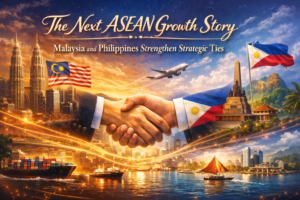
Philippine Ambassador Malaysia Ties Enter a New Era of Growth and Strategic Cooperation
As global supply chains shift and geopolitical tensions reshape trade routes, Southeast Asia is stepping into a powerful new role on the world stage. At the center of this transformation is ASEAN a 600 million strong economic bloc rapidly attracting attention from global powers including China, the United States, and Europe.
Amid this momentum, relations between Malaysia and the Philippines are not just holding steady they are accelerating.
Philippine Ambassador to Malaysia, Maria Angela Ponce, describes the bilateral relationship as “stable, strong, and forward-looking,” highlighting a partnership that is evolving beyond traditional diplomacy into a dynamic engine of regional growth.
A Partnership Rooted in History, Positioned for the Future

Malaysia and the Philippines share deep diplomatic roots dating back to the late 1960s, when both nations established embassies in each other’s capitals. Today, that foundation has matured into a strategic alliance anchored in trade, investment, and shared regional priorities.
The significance of this partnership was reinforced during the 2025 ASEAN Summit chaired by Malaysia, where Prime Minister Anwar Ibrahim emphasized unity, sovereignty, and regional stability principles that continue to define ASEAN’s collective identity.
With the Philippines set to chair ASEAN in 2026, the focus now shifts toward deeper integration, stronger economic corridors, and enhanced collaboration across key sectors.
Trade That Reflects Complementary Strengths
Economic ties between Malaysia and the Philippines continue to show resilience and steady growth.
Bilateral trade rose from US$8.15 billion in 2023 to an estimated US$8.29 billion in 2025, underscoring the strength of cross-border commerce. Malaysia remains one of the Philippines’ top trading partners, ranking ninth globally.
Rather than competing, both economies complement each other.
Malaysia exports refined petroleum, palm oil, machinery, and semiconductor inputs, while the Philippines contributes significantly through electronics manufacturing, coconut oil, and raw materials such as copper and rubber.
Electronics dominate the relationship, with integrated circuits accounting for nearly 39% of Philippine exports to Malaysia — a clear sign of deeply interconnected supply chains within the regional semiconductor ecosystem.
Investment Flows Accelerate
Beyond trade, investment is emerging as a powerful growth driver.
Malaysian investments into the Philippines surged to Php9.77 billion in 2024, a sharp increase from the previous year. Key sectors attracting capital include manufacturing, infrastructure, renewable energy, and digital services.
Malaysia now ranks among the top sources of foreign investment into the Philippines, reflecting growing confidence in the country’s economic reforms and long-term potential.
Efforts to address structural challenges particularly energy costs are also gaining traction. The Philippines is expanding its renewable energy capacity, positioning itself as an attractive destination for sustainable investments in solar, wind, and hydro power.
Digital and Halal Economies Take Center Stage
Looking ahead, both countries are placing strategic emphasis on emerging industries.
Digital finance, fintech innovation, and cross-border payment systems are becoming critical pillars of cooperation. Initiatives such as ASEAN’s digital connectivity frameworks and QR payment interoperability are already reshaping how businesses and consumers interact across borders.
At the same time, the halal economy presents a significant untapped opportunity.
With Malaysia’s global leadership in halal certification and the Philippines’ large consumer market, both nations are well positioned to build a powerful halal trade and finance ecosystem extending beyond food into pharmaceuticals, cosmetics, and Islamic banking.
ASEAN 2026: Navigating the Future Together

As the Philippines prepares to take on the ASEAN chairmanship in 2026 under the theme “Navigating the Future Together,” the focus will center on three core pillars:
- Peace and security
- Economic prosperity
- People empowerment
The roadmap builds on the ASEAN Community Vision 2045, aiming to strengthen regional integration while maintaining flexibility in an increasingly complex global environment.
A key lesson from recent global disruptions is clear: ASEAN must rely more on its internal market while continuing to engage global partners strategically.
Green Integration and Regional Connectivity
Sustainability is also rising to the top of the agenda.
The ASEAN Power Grid initiative seeks to enhance regional energy connectivity, enabling cross-border electricity trade and accelerating renewable energy adoption.
For the Philippines an archipelago of more than 7,000 islands geography is no longer a limitation.
“Waters do not divide us; they connect us,” Ponce noted, pointing to opportunities in submarine cables, energy infrastructure, and regional logistics networks.
These developments open the door for Malaysian engineering firms and energy companies to play a larger role in the Philippines’ green transition.
Stability in a Complex Geopolitical Landscape
On regional security, particularly tensions in the South China Sea, both nations remain aligned in advocating for peaceful resolution under international law.
Ongoing negotiations between ASEAN and China on a Code of Conduct — expected to conclude in 2026 — are seen as a critical step toward maintaining stability and safeguarding freedom of navigation.
Malaysia, serving as ASEAN’s coordinator in these negotiations, continues to play a key diplomatic role in balancing regional interests.
The Next Chapter: Scaling Up Collaboration
With the Philippine economy projected to grow between 5% and 5.5% in 2026, and ASEAN maintaining a strong outlook, the stage is set for deeper Malaysia–Philippines collaboration.
Priority sectors include:
- Semiconductor and advanced manufacturing
- Renewable energy and green infrastructure
- Agribusiness and food security
- Digital economy and fintech
- Halal industries and Islamic finance
As ASEAN prepares to expand with Timor-Leste’s inclusion, the region is entering a new phase of maturity — one defined not just by cooperation, but by collective ambition.
For Malaysia and the Philippines, the future is no longer just about maintaining stability.
